
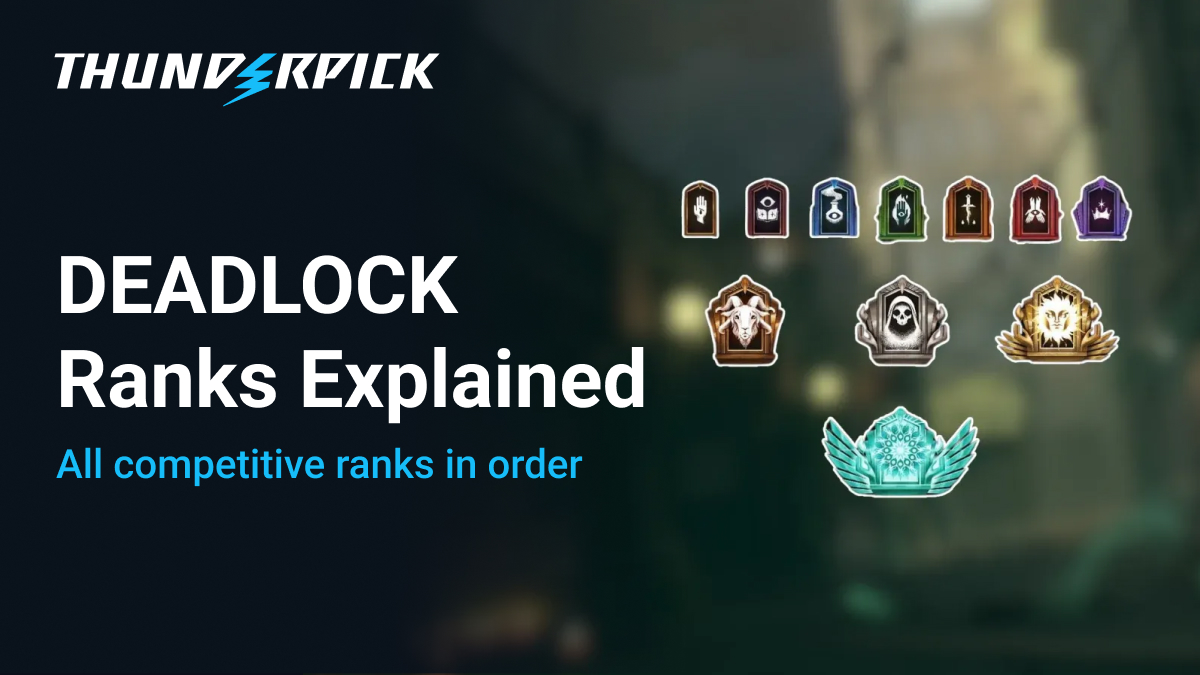
Deadlock ranks are designed to show you exactly where you stand on the competitive ladder, but the system is notoriously confusing. Much of this confusion comes from Valve’s ranked matchmaking overhaul, which left behind a ton of outdated information about skill ratings and how they actually work.
In this guide, we’ll detail everything about Deadlock ranks, including what they are, how skill ratings work, and what every rank and subrank means. We’ll also tell you where most players sit on the ranked ladder and how to improve your rating.
Table of Contents
What Are Deadlock Ranks?
Ranks (or “skill ratings”) are the primary measure of competitive skill level in Deadlock. While your true skill is calculated by a hidden numerical matchmaking rating (MMR), the game translates that math into a visual badge displayed directly on your profile.
The main purpose of skill ratings is to provide you with a sense of progression and show you precisely where you stand relative to the Deadlock player base. Everyone begins with a provisional rating of Obscurus until they play enough standard matches to calibrate their baseline skill.
Once assigned, your rank updates automatically after every match. More balanced games have greater adjustments than those with larger skill gaps. As you rank up, the matchmaking level will become progressively tougher – so don’t expect lobbies to get any easier en route to the top.

How Deadlock Ranked Works Today
Valve originally introduced skill ratings alongside a dedicated ranked mode on Oct. 10, 2024, allowing players to compete against opponents of comparable skill. It was heavily restricted, featuring fixed daily schedules, strict solo queue matchmaking, and a minimum match requirement to enter.
However, ranked mode was later removed on Nov. 21, 2024, with Valve consolidating standard and ranked matches into a unified skill-based matchmaking mode. They also relaxed party limits and removed matchmaking schedules to improve queue times and promote higher-quality matches.
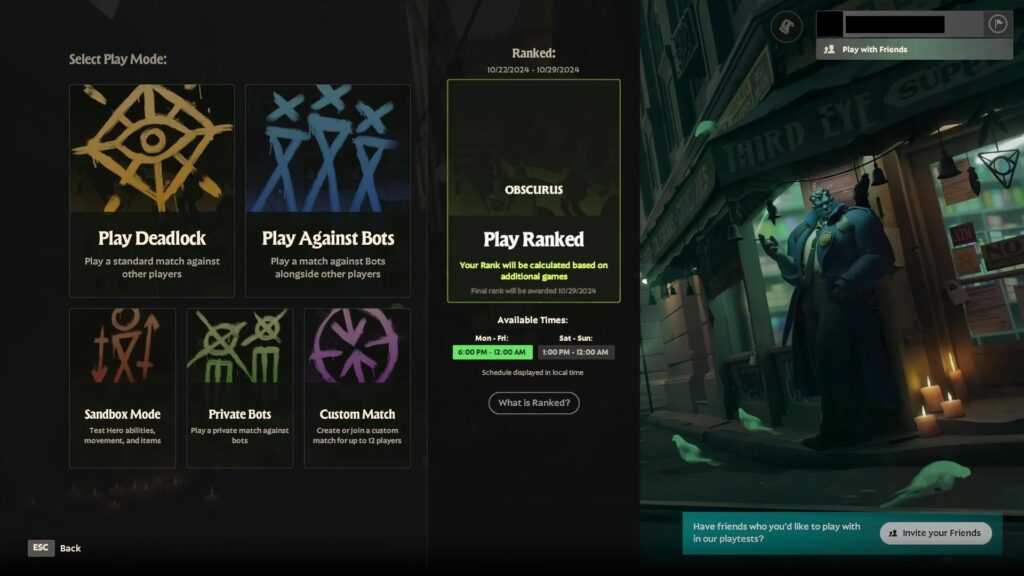
How To Access And Maintain Rank In Deadlock
With the ranked playlist removed, Deadlock’s rank system is now a lot simpler than before. Here is how to unlock and maintain your skill rating after the matchmaking overhaul.
How Rank Access Works Today
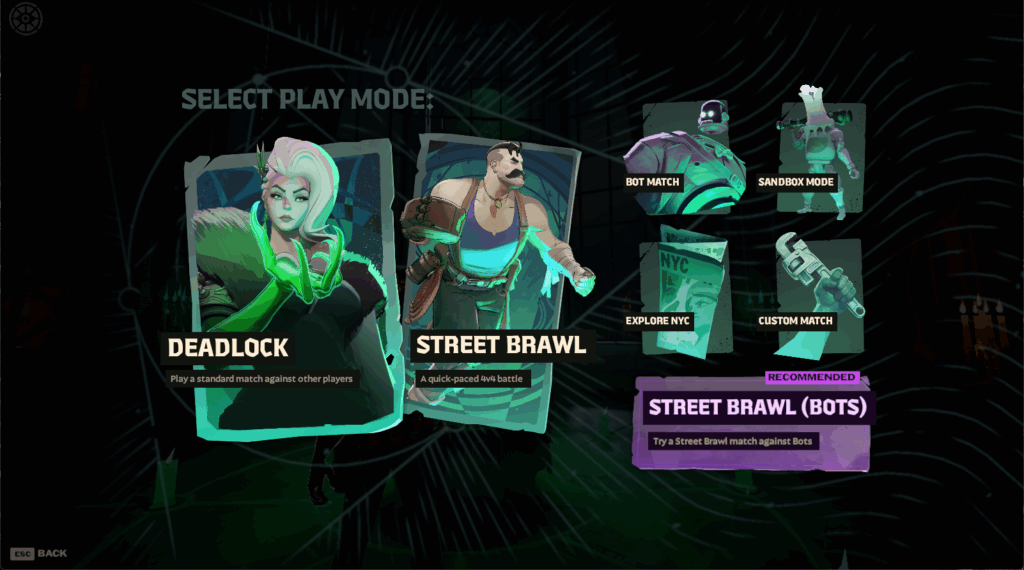
You can no longer unlock ranked mode in Deadlock because the dedicated playlist doesn’t exist. Instead, all rank progress is derived directly from playing standard matches. All you have to do now is play enough games until the matchmaking system has enough data to assign you a skill rating.
Before the matchmaking rework update on Nov. 21, 2024, Deadlock players had to meet the following requirements before they could queue for ranked matches:
- Play at least 50 standard games (excluding private, custom, or bot games).
- Have no behavior-related restrictions (e.g., voice or text bans, or misuse penalties).
Calibration Matches and Ongoing Rank Maintenance
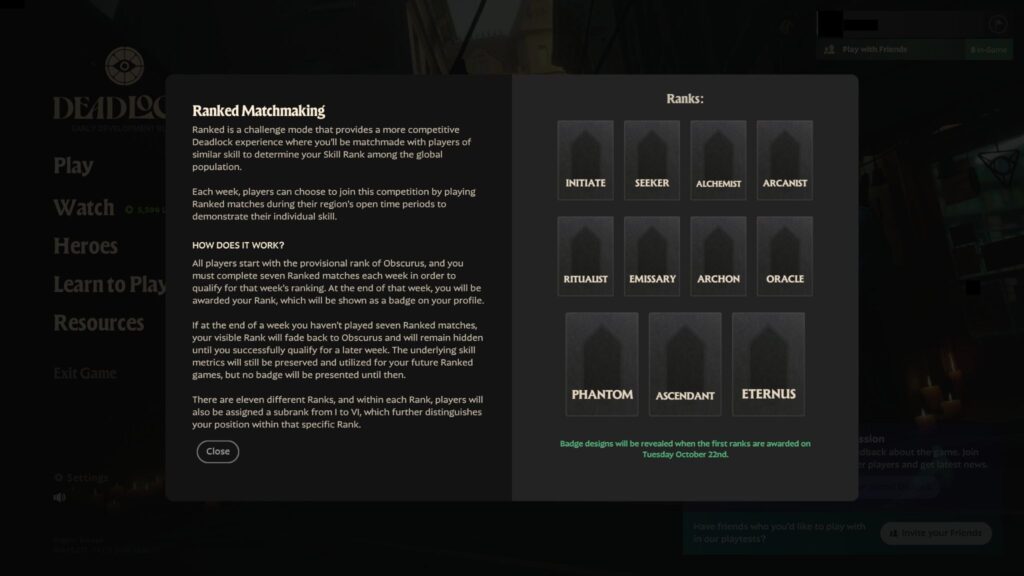
Deadlock no longer uses the weekly calibration system from its retired ranked mode. In the past, everybody began with a provisional rank of Obscurus and had to complete seven ranked matches per week to qualify for that week’s ranking. At the end of that week, you would be assigned a skill rating, displayed as a badge on your profile.
This badge would update weekly based on your highest rank, provided you played at least seven ranked matches. If you failed to meet this requirement, your badge would appear as Obscurus until enough ranked matches were played to recalibrate your skill rating. Rank calibration is now built directly into Deadlock’s matchmaking system and updates automatically through standard play. Your initial rank is assigned when the system has enough data to estimate your skill level. This usually takes 10 matches, though it could vary based on the system’s confidence.
Once a rank badge is assigned, it can change immediately at the end of a standard match, whenever you lose or gain enough MMR to move into a new rank threshold. This means you no longer have to wait for weekly updates or play a certain number of games. While there is no strict rank decay in Deadlock, you can still lose your visible skill rating after extended inactivity. When this happens, your rank temporarily resets to Obscurus until you play enough games to recalibrate it. However, since your MMR is preserved, it usually doesn’t take long for it to reappear.
Note: Valve may run occasional maintenance updates to readjust the global skill rating curve. These updates account for factors like player population changes, banned cheaters, and recalculation adjustments. They are performed ad hoc and could alter your rank, even without playing a match.
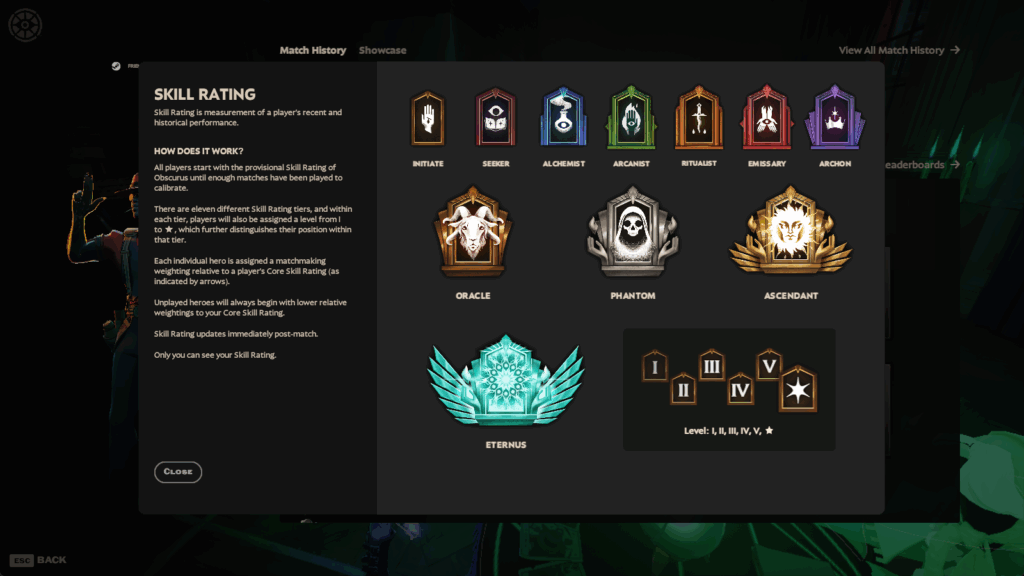
Deadlock Rank Structure And Progression
Deadlock uses different rank tiers to determine your level of skill. Here is a look at the ranking order, subranks, and hero-based matchmaking mechanics.
Rank Names, Order, and Subranks
There are currently 11 different skill rating tiers in Deadlock. They range from Initiate (the lowest rank) to Eternus (the highest rank), reserved for roughly the top 1% of players globally.
Except for Obscurus, which serves as a provisional or placeholder rating for inactive or uncalibrated players, all Deadlock ranks can be divided into six subranks (I to VI), with VI being the highest subrank within a given tier.
You must progress through every subrank before reaching the next tier. For example, if you’re in Arcanist II, you’ll need to progress through Arcanist III, IV, V, and VI before being promoted to Ritualist I. Similarly, dropping below the lowest subrank can demote you to the previous tier.
Here are all the Deadlock ranks and subranks in order:
| Rank | Badges |
| Obscurus |  |
| Initiate(I – VI) |  |
| Seeker(I – VI) |  |
| Alchemist(I – VI) |  |
| Arcanist(I – VI) |  |
| Ritualist(I – VI) |  |
| Emissary(I – VI) |  |
| Archon(I – VI) |  |
| Oracle(I – VI) |  |
| Phantom(I – VI) |  |
| Ascendant(I – VI) |  |
| Eternus(I – VI) |  |
How Is Skill Rating Determined?
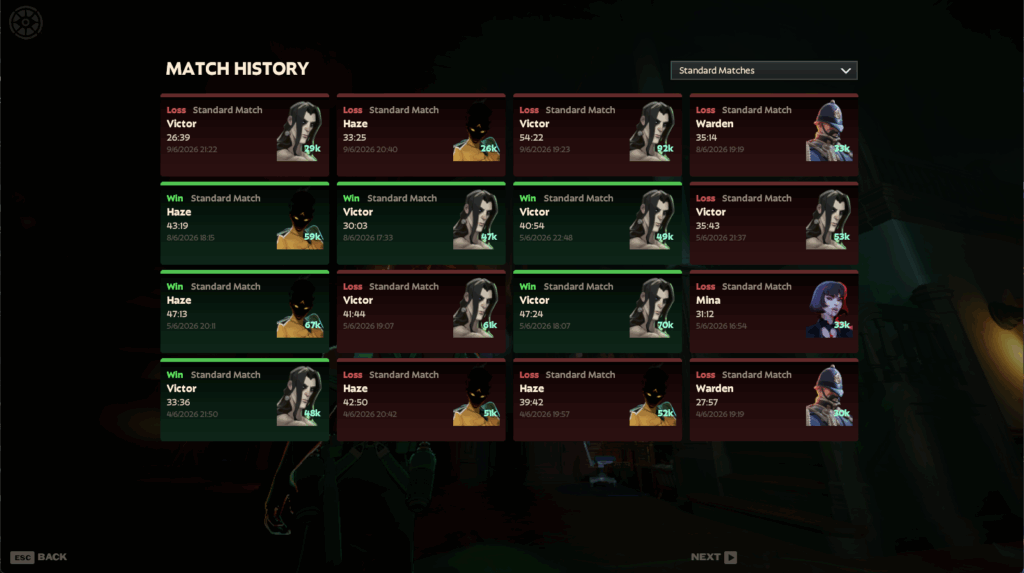
Valve has not publicly revealed the algorithm used to calculate skill rating in Deadlock, but rank progression appears to be primarily driven by wins and losses. Personal stats like kills and damage are not weighted as heavily. As a result, you’ll have to win games consistently to be promoted to the next rank.
However, you won’t be chasing a fixed numeric milestone. This is because Deadlock uses a percentile-based distribution system, meaning your visible rank badge is a reflection of your skill relative to the active player base. As such, the boundaries are dynamic and constantly fluctuate.
Your MMR gains and losses also depend on your party’s skill range, with greater disparity attracting more conservative adjustments. For example, if a high MMR player queues with a new account, the system may reduce rating changes until it can better determine the party’s true skill level.
ft. Valve
Core Skill Rating vs. Hero Skill Rating
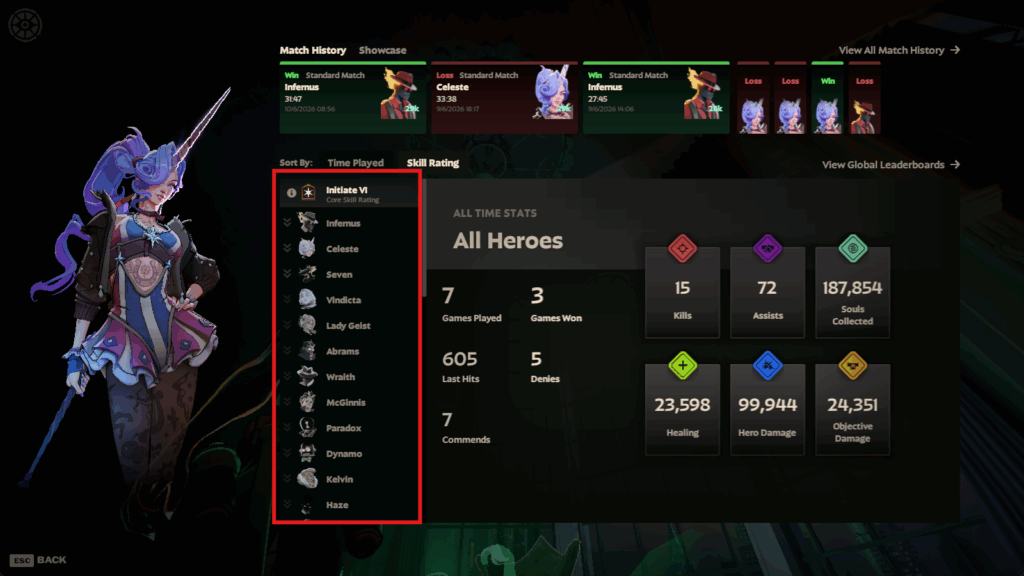
Deadlock has two types of ratings: (i) core skill rating and (ii) hero-based skill rating.
You can think of your core skill rating as your baseline skill level, while your hero rating reflects your proficiency with specific characters relative to your core value. This means the matchmaker could place you into slightly stronger or weaker lobbies depending on the hero you select.
For example, if you queue with a hero on which you have a strong performance history, your effective rating may be higher than your core rating. By contrast, if you choose a hero you rarely play or perform poorly with, your effective rating may be lower.
Hero ratings are represented by either green or gray arrows. Green upward arrows represent a rating above your core skill rating, while gray downward arrows indicate a rating below it. Unplayed heroes have two gray arrows and will always have a lower skill rating than your core skill rating.
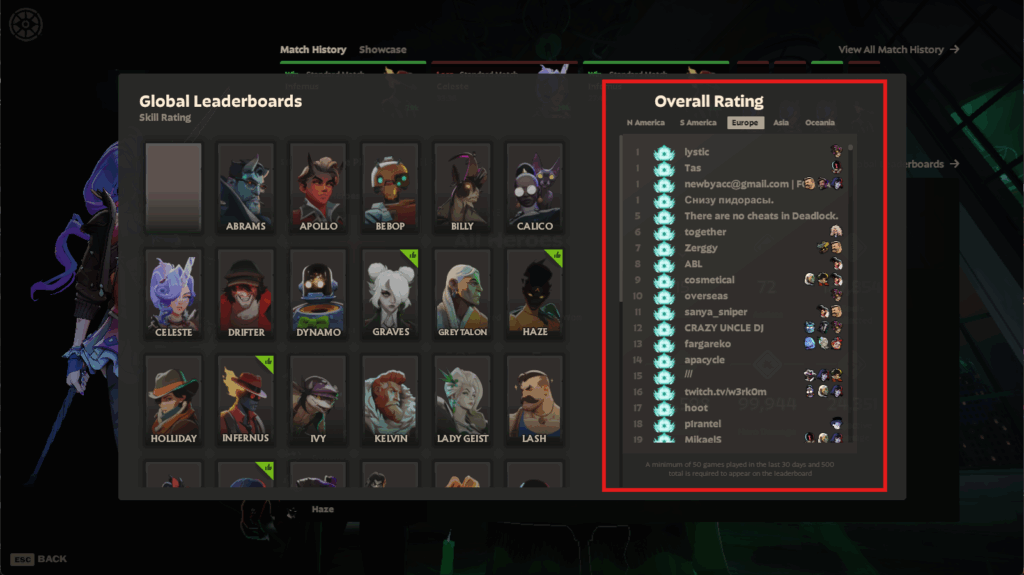
Global Leaderboards
There are also two types of global leaderboard systems in Deadlock across each major region (North America, South America, Europe, Asia, and Oceania):
- Core MMR Leaderboard: Ranks the top 1,000 players in each region based on their underlying MMR.
- Hero MMR Leaderboard: Ranks the top 1,000 players in each region separately for each hero.
To qualify for the global leaderboard, you must have played 50 matches within the last 30 days. If you want to rank on a specific hero’s leaderboard, you must also have played a minimum of 20 matches with that hero during the same 30-day period.
Badge and Profile Display
Skill rating badges act as personal markers of ranked progression, allowing you to track your improvement or gauge your lobby’s strength. That said, badges are based on hidden matchmaking data and hero-specific ratings, so players with identical badges could still have slightly different skill ratings.
You can view your skill rating directly on your profile by following these steps:
- Select Esc from the main menu.
- Click on your avatar icon in the top-right corner.
- Open the “Skill Rating” tab.
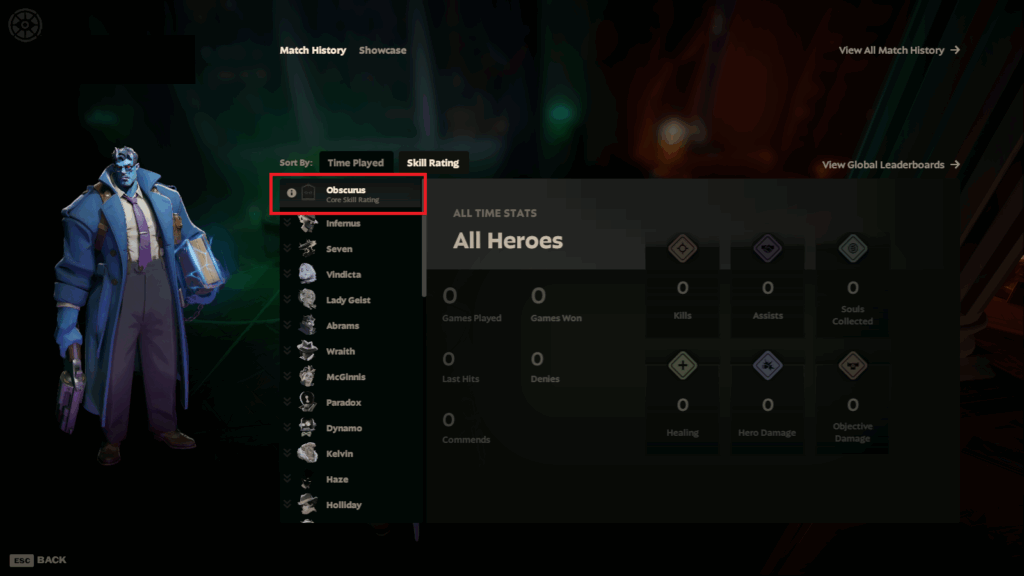
Importantly, you cannot view other players’ skill ratings, except through third-party sites like Statlocker or Tracklock, which provide estimated player rankings. However, you can view each team’s average skill rating on the post-game scoreboard and enable notifications for rating changes.
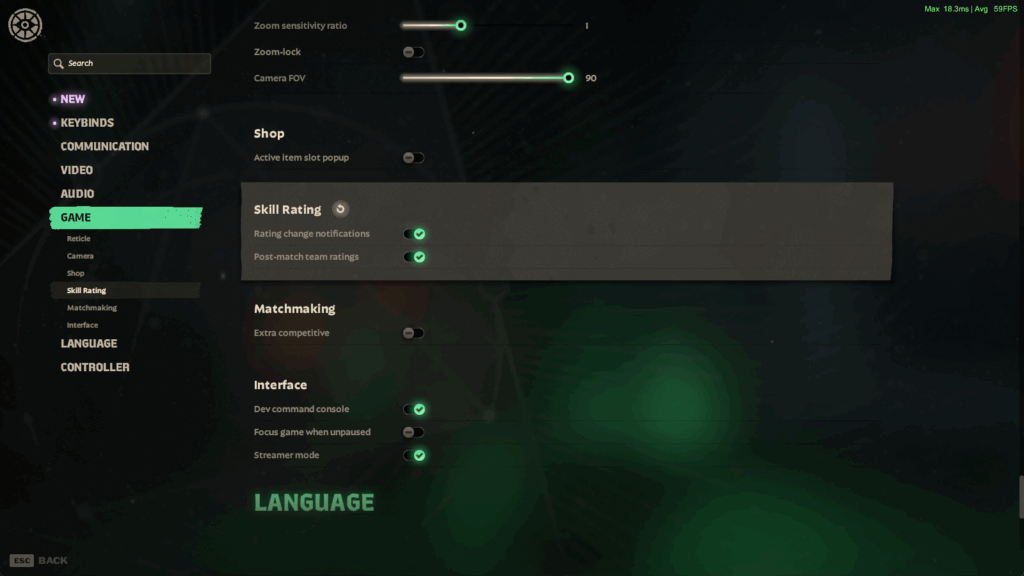
Here’s how to enable it:
- Press Esc from the main menu.
- Click on Settings.
- Go to the Game > Skill Rating tab.
- Enable “Rating change notifications” and “Post-match team ratings.”
You can also enable the “Extra competitive” setting under the Matchmaking tab to signal your preference for more coordinated, competitive teammates from the matchmaker.
Player Distribution Across Deadlock Ranks
Based on Statlocker’s match distribution by rank, it’s clear that a large share of Deadlock matches are concentrated around Ritualist (14.29%) and Emissary (13.89%). In particular, Ritualist V is the most populated subrank (2.42%), followed closely by Ritualist II and Emissary III (both 2.41%).
The lowest ranks, Initiate (7.51%) and Seeker (9.39%), account for a large chunk of the Deadlock player base, but the distribution increases rapidly into the mid-tiers. The distribution thins out near the top, with Phantom (4.42%), Ascendant (4.44%), and Eternus (1.11%) representing the elite section of the ladder.
It’s worth mentioning that Statlocker’s player profile distribution tells a slightly different story. While match data peaks around Ritualist and Emissary, the site’s profile chart (based on 306,102 accounts) places the median player at Archon, likely because higher-ranked players are more likely to track their stats.
Here’s the current Deadlock rank distribution, which you can use to benchmark your progress and see how close you are to the upper end of the ladder:
| Rank | Matches | Percentage | Percentile |
| Initiate I | 742,987 | 1.99% | 1.99% |
| Initiate II | 545,904 | 1.46% | 3.46% |
| Initiate III | 289,707 | 0.78% | 4.24% |
| Initiate IV | 345,194 | 0.93% | 5.16% |
| Initiate V | 399,583 | 1.07% | 6.23% |
| Initiate VI | 477,731 | 1.28% | 7.51% |
| Seeker I | 518,693 | 1.39% | 8.90% |
| Seeker II | 585,393 | 1.57% | 10.47% |
| Seeker III | 663,996 | 1.78% | 12.25% |
| Seeker IV | 539,010 | 1.45% | 13.69% |
| Seeker V | 579,406 | 1.55% | 15.25% |
| Seeker VI | 617,554 | 1.66% | 16.90% |
| Alchemist I | 659,049 | 1.77% | 18.67% |
| Alchemist II | 706,681 | 1.89% | 20.57% |
| Alchemist III | 747,464 | 2.00% | 22.57% |
| Alchemist IV | 694,127 | 1.86% | 24.43% |
| Alchemist V | 703,971 | 1.89% | 26.32% |
| Alchemist VI | 707,283 | 1.90% | 28.21% |
| Arcanist I | 834,475 | 2.24% | 30.45% |
| Arcanist II | 845,032 | 2.27% | 32.72% |
| Arcanist III | 821,890 | 2.20% | 34.92% |
| Arcanist IV | 832,176 | 2.23% | 37.15% |
| Arcanist V | 836,195 | 2.24% | 39.39% |
| Arcanist VI | 842,159 | 2.26% | 41.65% |
| Ritualist I | 888,606 | 2.38% | 44.03% |
| Ritualist II | 897,774 | 2.41% | 46.44% |
| Ritualist III | 881,634 | 2.36% | 48.80% |
| Ritualist IV | 869,620 | 2.33% | 51.13% |
| Ritualist V | 901,166 | 2.42% | 53.55% |
| Ritualist VI | 890,722 | 2.39% | 55.94% |
| Emissary I | 874,980 | 2.35% | 58.28% |
| Emissary II | 830,233 | 2.23% | 60.51% |
| Emissary III | 897,216 | 2.41% | 62.91% |
| Emissary IV | 874,775 | 2.35% | 65.26% |
| Emissary V | 864,602 | 2.32% | 67.58% |
| Emissary VI | 839,335 | 2.25% | 69.83% |
| Archon I | 756,800 | 2.03% | 71.86% |
| Archon II | 696,149 | 1.87% | 73.73% |
| Archon III | 650,018 | 1.74% | 75.47% |
| Archon IV | 611,597 | 1.64% | 77.11% |
| Archon V | 596,363 | 1.60% | 78.71% |
| Archon VI | 591,376 | 1.59% | 80.30% |
| Oracle I | 724,132 | 1.94% | 82.24% |
| Oracle II | 681,287 | 1.83% | 84.06% |
| Oracle III | 634,269 | 1.70% | 85.76% |
| Oracle IV | 583,165 | 1.56% | 87.33% |
| Oracle V | 538,960 | 1.45% | 88.77% |
| Oracle VI | 470,039 | 1.26% | 90.03% |
| Phantom I | 350,463 | 0.94% | 90.97% |
| Phantom II | 313,716 | 0.84% | 91.81% |
| Phantom III | 277,473 | 0.74% | 92.56% |
| Phantom IV | 248,132 | 0.67% | 93.22% |
| Phantom V | 235,224 | 0.63% | 93.85% |
| Phantom VI | 223,961 | 0.60% | 94.45% |
| Ascendant I | 420,046 | 1.13% | 95.58% |
| Ascendant II | 348,999 | 0.94% | 96.52% |
| Ascendant III | 291,617 | 0.78% | 97.30% |
| Ascendant IV | 238,476 | 0.64% | 97.94% |
| Ascendant V | 192,133 | 0.52% | 98.45% |
| Ascendant VI | 164,063 | 0.44% | 98.89% |
| Eternus I | 59,619 | 0.16% | 99.05% |
| Eternus II | 65,017 | 0.17% | 99.23% |
| Eternus III | 63,907 | 0.17% | 99.40% |
| Eternus IV | 64,796 | 0.17% | 99.57% |
| Eternus V | 74,680 | 0.20% | 99.77% |
| Eternus VI | 84,314 | 0.23% | 100.00% |
Note: This data was sourced from StatLocker and reflects tracked matches by rank as of June 10, 2026. Percentages are based on a total of 37,297,114 recorded matches.
Strategies For Success In Deadlock Ranked
If you want to climb the ladder in Deadlock, it’s important to realize that it’s not all about grinding matches. Yes, skill matters, but so does having a solid strategy and executing it consistently. At the same time, try to identify your mistakes and actively work toward improving them.
To help you escape the trenches, here are some top tips to improve your rank in Deadlock:
- Regularly use The Atrium (from the lobby) or Sandbox modes to practice core mechanics, such as movement, aim, positioning, abilities, and farming.
- Master your hero’s abilities, timings, cast times, combo potential, and items to bait out enemy skills and aggressively punish opponents when they’re vulnerable.
- Pay attention to your hero-specific skill ratings. Specializing in one or two heroes can help you rank up faster than spreading your practice across too many heroes.
- Try out off-weapon builds by stacking Spirit Power and active items. By reducing your reliance on gun damage, you can counter bullet-resistant enemies using ability combos.
- Communicate with your team using text or voice chat to coordinate pushes. Even simple callouts like “push yellow” or “group up” are enough to win fights or avoid throwing away a lead.
- Watch replays of losses to identify repeated mistakes and ask better players or coaches for feedback.
Deadlock Ranks FAQ
Deadlock’s skill rating system has changed a lot since ranked mode was removed, so these answers should clear up the most common points of confusion.
How Do I Unlock Ranked In Deadlock?
You do not need to unlock a separate ranked mode in Deadlock anymore because Valve removed the playlist on Nov. 21, 2024. Rank progression is now linked to standard mode matches and the skill rating system.
What Happens If I Don’t Play Ranked For A Week?
Since Valve removed weekly rank updates, nothing major happens to your skill rating after only a week of not playing Deadlock. You will maintain your badge and, since there’s no strict rank decay, your underlying MMR will be unchanged.
How Do Ranks And Subranks Work?
Deadlock has 11 rank tiers, ranging from Initiate to Eternus. Each tier has six subranks (I to VI), with VI being the final step before promotion to the next tier. You must earn enough MMR to rank up, which generally means consistently winning matches over time.
Where Do I See My Rank?
Your Deadlock rank appears as a badge under the Skill Rating tab on your profile. It’s not currently possible to view individual skill ratings of other players. However, you can view the average lobby skill tier on the post-match scoreboard and check specific player stats using third-party trackers.
What Is The Average Player Rank?
It depends because Valve actively readjusts the global skill rating curve. Currently, the average rank in Deadlock is around Ritualist IV to Ritualist V, roughly representing the 50th percentile of all players.
Do Private Games Count Toward Ranked Unlock?
No. Private games do not count toward ranked unlock or skill rating in Deadlock. Only standard matches are eligible for rank progression.
Always practice Responsible Gambling and check out our latest promo offers and boosts. T&Cs apply. 18+ to play.