

Lets face it: There’s a lot of Dota 2 tournaments around these days. A half dozen organizers with multiple event series that clog the competitive Dota 2 calendar with competitions that could be great, or could be flops.
But in a season overloaded with qualifiers, fragmented schedules, and inconsistent tournament formats, PGL Wallachia Season 8 managed to stand out for a surprisingly simple reason: Almost every elite team in the world was there. And beyond that, the event didn’t even bother holding qualifiers, it was just invite-only. No regional teams there just to fill a spot, no duds. And as a result, not many one-sided group-stage matches to kill the momentum.
Instead, statistically, PGL Wallachia Season 8 was the highest skill tournament we’ve seen in Dota 2 in months. And as a result, we got some great games, some incredible performances, and not just another event with a clear winner from day one
Why Wallachia Season 8 Felt Different
PGL Wallachia Season 8 featured 16 directly invited teams. Rather than rely on qualifiers, the tournament hand-picked the squads they wanted, giving us one of the statistically highest-ranked events in recent memory. The squads involved were all within the top-20 of the EPT and SAP Liquipedia rankings.
From BetBoom Team and Team Falcons, Team Liquid and Tundra, to Team Spirit and Aurora Gaming, nearly every major contender in contemporary competitive Dota attended the event.
The modern Dota 2 ecosystem has become increasingly chaotic since Valve moved away from the Dota Pro Circuit. Teams juggle overlapping events, regional circuits, online qualifiers, and almost non-stop travel schedules. Top organizations frequently skip tournaments entirely, while many events struggle to secure a balanced field.
Because of this, viewers have grown accustomed to uneven competitions. Many tournaments begin with predictable stomps between elite teams and clearly underqualified opponents. Meanwhile, some events feature weak regional representatives that simply cannot compete internationally. But Wallachia Season 8 avoided nearly all of those issues because the tournament relied entirely on direct invitations. PGL were able to prioritize consistency and elite-level competition over pure qualification meritocracy. And as result, we got some huge upsets in the group stages.
Through the Swiss round-robin group stage we saw Tundra Esports and Team Yandex, pre-tournament favorites, and winners of the last two top-flight Dota 2 events eliminated in last place. And in their place, South American teams Heroic and South America Rejects shot into the top spots, flying past veteran teams like Xtreme Gaming and MOUZ.
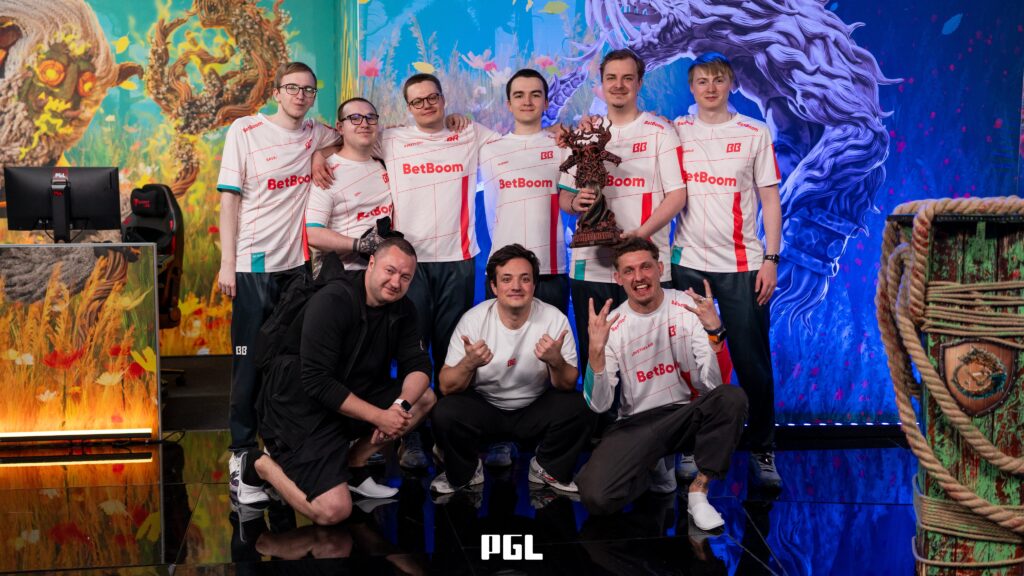
And ultimately, the tournament ended in a surprise: BetBoom lifting the trophy after months of underperforming against an Aurora team we’re all still looking to celebrate a victory with. It was a great moment for fans, and a big event. And that came from a seemingly ‘uncompetitive’ tournament.
The Competitive Integrity Argument
On paper, invite-only systems should be controversial, because it’s not meritocratic. Open qualification structures exist for a reason: They protect competitive integrity, reward current form rather than reputation, and stop the whole competitive scene from becoming predictable. We all remember those miserable times when Nigma Galaxy and OG were still getting invites despite not performing.
Historically, some of esports’ greatest moments have come from underdog qualification runs, especially in Dota 2. And if you get rid of them, you really start to go against the philosophy of the game. After all, there was outrage when The International temporarily stopped open qualifiers a few years ago. For many fans, the dream of a team being able to go from nothing to millions of dollars at TI was a core part of competitive Dota.
Unknown rosters upsetting established organizations is part of what gives competitive Dota 2 its identity. Open systems create hope for smaller teams and prevent tournament ecosystems from becoming completely closed off around partner organizations.
And without qualifiers, there is always the risk of stagnation. A fully invite-only circuit can eventually become repetitive, predictable, and disconnected from the broader competitive scene. Emerging teams lose opportunities, regional representation shrinks, and the ecosystem becomes heavily dependent on brand value rather than actual results.
Fans want the best matches possible
Even with those concerns, Wallachia Season 8 demonstrated why so many fans still gravitate toward stacked invitationals. The average quality of games throughout the event was exceptionally high. If you love Dota, this was a tournament for you. The emergence of broken heroes like Lone Druid and Tinker forced drafts to dive deeper and players to execute at a level far beyond other recent events. There were very few “wasted” series. And in contrast, if a team lost a match, it was a big deal.
That matters in a crowded esports landscape where viewers have limited time and infinite alternatives. Modern audiences are less willing to sit through long stretches of low-stakes matches just to reach the later stages of a tournament. Two-week DreamLeagues and low-stakes events can kill momentum.
We also live in a Dota 2 world where competitive standings move faster than qualifiers can even handle. Blast SLAM VII held its qualifiers at the beginning of April. Looking at the lineup now, can we honestly say that the games best teams will be in attendance? But another major reason Wallachia Season 8 received positive community feedback was its broadcast talent lineup. Fans praised the inclusion of former professional players, veteran analysts, and long-time fan-favorite casters who helped make the event feel authentic and community-driven.
And yet, all this sounds great… but there’s a problem. The viewership doesn’t match what I’ve been saying.
The viewership problem
Ironically, PGL Wallachia Season 8 became the least-watched Wallachia tournament in the past three years despite featuring one of the strongest lineups in recent memory.
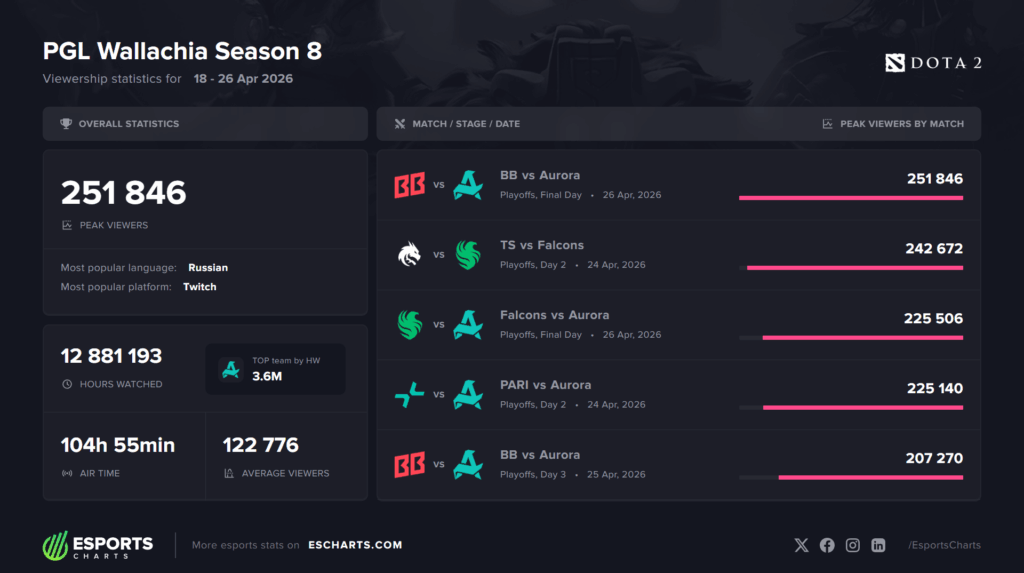
That disconnect says a lot about modern esports audiences. Fans do not simply watch tournaments because the gameplay is technically superior. They also care about emotional investment, regional pride, personalities, rivalries, and, perhaps most crucially, their favorite teams.
BetBoom Team versus Aurora Gaming just didn’t excite people. With fan favorites eliminated early, and teams like Liquid, Tundra, and Falcons not making it to the final days, it seems like viewership was hurt. There’s also timing. Dropping on a busy April weekend, with lots of holidays and breaks across the globe, perhaps fans were just doing something else during the event. Beyond this, we’re also four months deep in a run of constant Dota 2 tournaments.
I’ve often complained that the Dota 2 season doesn’t really have a beginning and end. As a result, fans must decide for themselves when to take a break from watching, and perhaps that has to come during the second of three PGL Wallachia events this year.
Ultimately, there likely needs to be a balance. We’d love to see a few more direct invite tournaments, and if PGL Wallachia is the organizer to do them, then even better. But the company must also make sure it’s capitalizing on the timing and energy of Dota 2 fans.